
Conventional thinking about metaphor is that they're primarily *aesthetic*, only occasionally a tool for understanding or thought. The theory of **conceptual metaphor** gives metaphor a central role in both understanding and problem-solving.
This page needs more work before it's ready for outside review.
table of contents
The argument proceeds as follows:
1. A brief summary of the conventional view.
2. Conceptual metaphor, explained.
3. Some interesting details that might help you be more alert to people's use of metaphors (including your own). That's how it worked for me, and I like to think it's helped me a bit toward that elusive sense of *completeness* or *coherence* or *Through-Line*» that I strive for.
the conventional view
Suppose Rachel says to Stu, "the cat is on the mat." According to a widely-held theory of language, Stu's brain translates those auditory impressions into a **mental structure** that I might draw like this:
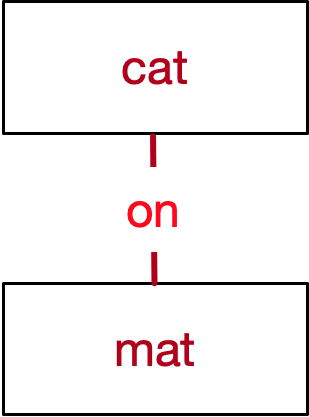
Uploaded image
The nature of the structure isn’t important here. What matters is that Stu can reason about it. That means, roughly, that he can produce new structures from it. For example, this structure can be combined with other structures to draw the correct conclusion that the cat is not up in a tree.
Now consider that Rachel makes the metaphorical statement that “Our marriage is at a crossroads.” This is clearly false – marriages can’t literally be in places. Stu assume Rachel is trying to say something useful, so the sentence can be translated in two phases:
1. Some sentence that Rachel would have said were she speaking literally instead of metaphorically.
2. The literal sentence is translated into a structure.
(Whether these actually happen in separate stages is irrelevant.) So the ending structure is something complex that conveys that Stu and Rachel have a joint problem, that it relates to their marriage, that some choices need to be made, possibly that there’s not enough information to make those choices wisely, that Stu is wise to be anxious and treat the matter as of some importance, and so on. It seems likely to me that metaphors are used in large part because it would take many more words to be literal, but that’s just an idea of mine, not something I remember seeing in the literature. The important thing is that all reasoning is done using the final structure. No residue of “crossroads” or “journeys” or any of that is relevant.
conceptual metaphor
see also
support
<div style="text-align: center">How to Read — Other Ways to Browse</div>
<div style="text-align: center">Recent Changes –– Admin </div>